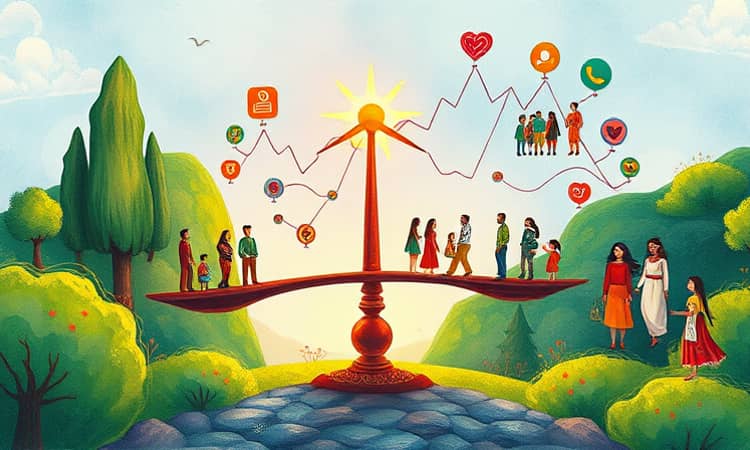
For decades, Gross Domestic Product (GDP) has governed policy debates and defined national success. Yet as societies face climate threats, inequality, and mental health crises, experts ask: is GDP enough? This article explores powerful alternatives that capture the full spectrum of human and planetary welfare.
The Historical Dominance and Core Flaws of GDP
Since the mid-20th century, GDP has served as the go-to metric for economic performance. It sums the value of final goods and services produced, tracking consumption, investment, government spending, and net exports. While GDP growth signals higher production, it fails to reveal underlying consequences.
Critics point out that GDP ignores environmental degradation and resource depletion and overlooks unpaid work in homes and communities. High GDP can coincide with rising carbon emissions, collapsing ecosystems, and growing social divides, leaving millions without basic services or life satisfaction.
Emergence of Alternative Metrics
In 2009, the Stiglitz Commission urged richer measures of progress. The United Nations responded in 2015 with Sustainable Development Goal 17.19, calling for “beyond-GDP” indicators by 2030. Over 200 proposals emerged, reflecting diverse priorities across regions and disciplines.
- Stiglitz Commission recommendations on well-being
- UN SDG 17.19’s call for holistic data
- National frameworks by OECD, European Commission, and New Zealand
Major bodies now champion indicators encompassing health, education, equality, and environmental quality, forging a global momentum for change.
Key “Beyond GDP” Indicators at a Glance
Below is a snapshot of leading metrics redefining economic health.
Common Dimensions and Methodological Advances
Analyzing over 200 indicators reveals shared themes. Metrics increasingly track life satisfaction, health, education quality, social cohesion, and environmental integrity alongside income and consumption. They also emphasize equality by including gender and wealth distribution.
- Life satisfaction, health, and life expectancy
- Education access, crime, safety, and governance
- Environmental quality and planetary boundaries
Innovations include dynamic, nonlinear models treating economies as part of social-ecological systems. Researchers recommend tracking stocks (natural, human, social capital) and flows (ecosystem services, monetary) and integrating qualitative community feedback for localized insights.
National and Local Innovations in Practice
Several governments and cities have pioneered “beyond GDP” adoption, turning theory into policy. In New Zealand, the Living Standards Framework embeds well-being into budgeting and legislation. U.S. states such as Maryland, Hawaii, and Vermont publish Genuine Progress Indicators to guide environmental and social programs.
- New Zealand’s Living Standards Framework drives fiscal policy
- GPI reports in Maryland, Hawaii, and Vermont inform public spending
- City-level indexes in San Francisco and Baltimore shape urban planning
International cooperation, led by the UN and OECD, is standardizing definitions and best practices, while UNCTAD calls for a dedicated global body to steward these metrics.
Policy Implications and Future Directions
Broadening success measures can transform public investment priorities, from infrastructure and education to green technologies and mental health services. Publishing well-being data reshapes public discourse about what prosperity truly means.
Debates persist over subjectivity in valuing unpaid work and happiness surveys, data gaps in developing countries, and political resistance from institutions entrenched in GDP-based models. Yet pressures from the SDGs drive wider adoption, with target deadlines looming in 2030.
Emerging themes include aligning resource use with planetary boundaries, establishing an accountable global governance framework, and amplifying youth and marginalized community voices in metric design and implementation.
The Vision for 21st Century Prosperity
As the world confronts inequality, climate change, and social unrest, we need metrics that reflect resilience, equity, and sustainability. By embracing holistic measures, policymakers can craft strategies that nurture healthy ecosystems and flourishing communities.
Only by defining prosperity for the future can societies ensure that economic growth enhances genuine well-being rather than merely inflating statistical aggregates. It is time to look beyond GDP and reimagine global economic health for generations to come.