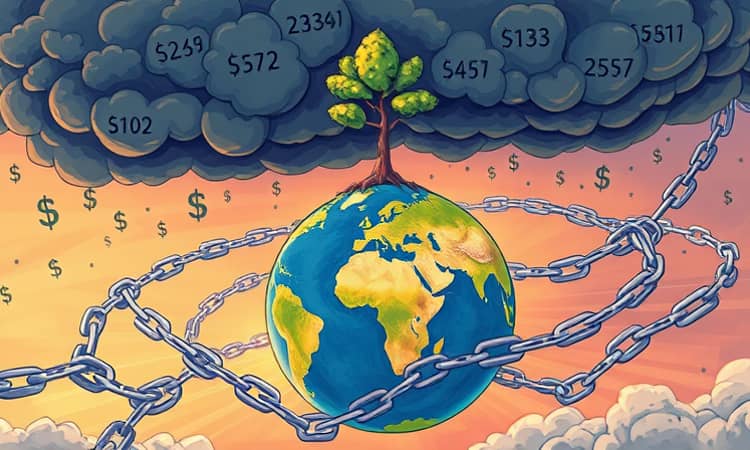
The world stands at a critical crossroads as debt levels soar to heights never seen before. Governments, corporations, and households have collectively amassed a historically unprecedented level of debt, raising alarms across financial markets, policy circles, and academic debates. With estimates placing total liabilities above $324 trillion in early 2025, experts warn of looming tremors that could trigger severe economic upheaval.
This article offers a comprehensive snapshot of global leverage and explores the multifaceted drivers behind rising obligations. We examine regional divergences, potential triggers for a collapse, lessons from history, and the policy dilemmas confronting central banks. Finally, we chart practical steps individuals and institutions can take to navigate an uncertain financial landscape.
Current State of Global Debt
As of Q2 2025, total global debt ranges between $324 trillion and $338 trillion, depending on coverage and measurement methodology. While the debt-to-GDP ratio has eased slightly from its 2020 peak of 258% to about 235%, it remains well above pre-pandemic norms. This burden is split roughly between public and private sectors, reflecting different risk profiles and sustainability concerns.
Notable national figures include the U.S. at 121% of GDP in 2024, projected to rise further, Japan at 256%, and China at 88%, each with unique fiscal and monetary challenges. Sovereign bond issuance by OECD countries is set to hit a record $17 trillion in 2025, underscoring the global appetite for new borrowing.
Key Drivers Behind Surging Liabilities
Several interlocking factors explain why debt has ballooned to such magnitudes, with some trends predating the recent crises:
- Persistent fiscal deficits and demographic pressures driven by aging populations and rising entitlement spending.
- Post-pandemic liquidity injections and cheap borrowing under zero interest policies that encouraged extensive leverage.
- Climate change mitigation costs and resilience investments tied to deglobalization and reshoring.
- Investment mismatches where new debt often fails to generate sufficient productive capacity.
These forces combined make meaningful deleveraging rare, as fiscal tightening risks economic contraction and social backlash, leaving policymakers in a delicate balancing act.
Regional Divergence and Impact
Debt dynamics vary significantly across regions. Advanced economies have seen private debt levels retreat slightly, but public debt has widened, particularly in countries that implemented large stimulus programs. Emerging markets exhibit a mixed picture: private borrowing soared in large economies like Brazil and India, while others saw modest retrenchment. Excluding China, average public debt in emerging markets hovers around 56% of GDP, offering some fiscal breathing room, though volatility remains high.
China’s non-financial corporate debt has climbed to 206% of GDP, signaling potential corporate balance sheet strains if growth slows further. Meanwhile, Japan’s debt sustainability relies heavily on domestic financing, posing risks if demographic decline alters bond demand.
Potential Triggers for the Bubble Burst
Financial markets operate on confidence and liquidity. Should tipping points be reached, the cascade of events could be swift and unforgiving. Key trigger scenarios include:
- An abrupt rise in global interest rates leading to widespread refinancing stress.
- Disruption in the U.S. Treasury or major sovereign bond markets, eroding safe-haven status.
- Systemic global liquidity and credit risk emerging from drying repo facility balances and counterparty caution.
- A sudden loss of investor confidence prompting a sudden market-wide deleveraging event.
Any combination of these shocks could prompt a modern-day “Minsky Moment,” where the veneer of stability gives way to rapid asset deflation and credit exhaustion.
Historical Lessons and Theoretical Insights
History offers sobering parallels. From post-World War I debt restructuring to the 2008 global financial crisis, periods of rapid debt accumulation were often followed by painful adjustments. Theoretical frameworks on financialization emphasize the shift from productive investment toward debt-financed speculation, which can eventually undermine growth prospects.
Debates persist on whether national debts must be repaid or can be managed indefinitely. Modern monetary theory proponents argue that sovereign issuers of fiat currency face no solvency constraints, while traditionalists warn of runaway inflation and currency devaluation if debt grows unchecked.
Role of Central Banks and Policy Dilemmas
Central banks remain frontline defenders against economic collapse, yet they face their own conundrums. Maintaining low rates encourages borrowing but risks inflating asset bubbles. Conversely, tightening monetary policy to curb inflation can ignite debt servicing crises.
Quantitative tightening and easing policies illustrate the escalator up, elevator down dynamic, where rate hikes are gradual but cuts are swift and deep in downturns. This asymmetry can exacerbate boom-bust cycles and challenge long-term financial stability.
Future Outlook and Navigating Uncertainty
Looking ahead, sovereign debt-to-GDP ratios in advanced economies are projected to climb to 123% by 2030. Record bond issuance is expected to continue, even as demographic headwinds and climate-related expenditures mount.
Practical strategies for institutions and individuals include:
- Stress-testing balance sheets against multiple shock scenarios.
- Diversifying asset allocations to include real assets, inflation-protected securities, and quality credit exposures.
- Maintaining sufficient liquidity buffers to weather sudden market dislocations.
Charting a Way Forward
There is no single panacea to the global debt dilemma. Addressing it will require coordinated policy action, fiscal prudence, and structural reforms aimed at boosting productivity and sustainable growth. Transparency and international cooperation are essential to manage rollover risks and avert a disorderly debt crisis.
Ultimately, the path forward rests on our collective ability to balance short-term stabilization with long-term resilience. By learning from past mistakes, deploying prudent policy measures, and fostering robust financial systems, we can hope to deflate the debt bubble gradually rather than endure a sudden, painful burst.