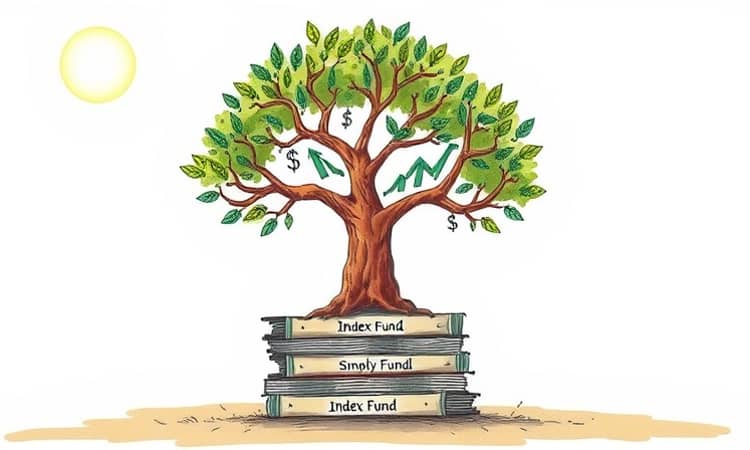
In a world of complex financial strategies and market speculation, index investing stands out as a beacon of clarity and efficiency. By embracing a straightforward approach that mirrors broad market indices, investors can achieve substantial long-term growth with minimal effort and cost.
Understanding Index Investing
Index investing refers to the practice of purchasing funds that track a market benchmark such as the S&P 500, Nifty 50, or Dow Jones Industrial Average. Rather than trying to outguess market movements, index funds and ETFs aim to match market performance by holding shares of all—or a representative sample—of the companies in the chosen index.
This form of investing is categorized as passive fund management. Unlike active managers who conduct research and time trades in hopes of outperforming benchmarks, passive funds accept market returns as their target. The simplicity of this mechanism is one of its greatest appeals, especially to investors seeking a “set and forget” investing experience.
Historical Performance & Statistics
Over the past decades, index funds have proven their resilience and consistency. As of September 2025, the assets under management in indexed mutual funds and ETFs in the U.S. reached a staggering $18.59 trillion, compared to $17.23 trillion in active funds. This shift underscores the growing investor preference for low-cost, transparent vehicles that emulate broad market returns.
Consider the quarterly performance of the Vanguard Total Stock Market Index Fund in Q3 2025: it delivered an impressive 8.2% return, outperforming the average large-blend active fund by 1.3 percentage points. From 1992 through 2025, the S&P 500 experienced positive monthly returns in 63% of all months—a testament to the market’s upward drift over time.
Multi-year metrics further highlight the power of indexing. The Invesco QQQ Trust, tracking the NASDAQ-100, averaged 31.8% per year from 2022 to 2025, while most active peers underperformed their benchmarks. According to SPIVA mid-2025 data, 68% of fixed-income and 42% of equity active funds failed to match index returns.
Core Benefits of Index Investing
Investors choosing indexed strategies enjoy a suite of advantages that accumulate over the long haul:
- Low Expense Ratio: Fees often range from 0.03% to 0.15% annually, a fraction of active fund costs.
- Immediate Sector Diversification: One purchase can spread risk across hundreds or thousands of stocks.
- Tax Efficiency: Passive management means fewer taxable capital gains distributions.
- Consistent Market Representation: Returns reliably mirror broad market trends without major surprises.
Risks and Criticisms
While index investing offers clear advantages, it is not without limitations. Understanding these trade-offs empowers investors to align their strategies with their risk tolerance.
- Market Risk: An index fund will decline alongside its benchmark during a systemic market downturn.
- No Outperformance Potential: Passive funds aim to replicate, not beat, benchmark returns, ceding any chance of extraordinary gains.
- Top-Heavy Weighting: Capitalization-weighted indices grant oversized influence to giant companies, muting smaller stocks’ contributions.
- Tracking Error: Slight deviations can occur due to fees and fund management logistics.
Cost Comparison Table
Examining fees and turnover rates clarifies why costs compound significantly over decades.
Who Should Embrace Index Investing?
Index funds suit a broad spectrum of investors, particularly those who prioritize simplicity and cost savings. This approach aligns with:
- Long-Term Planners: Investors with horizons of 10 years or more who benefit most from compounding and low fees.
- Cost-Conscious Participants: Those who understand that small savings compound significantly over time.
- Tax-Sensitive Portfolios: Investors seeking low turnover-driven tax efficiency to keep more gains in their pockets.
- Beginner Investors: Individuals drawn to transparent, easy-to-understand strategies.
Strategies and Options for Implementation
Diversifying across different indices and fund structures can optimize an indexed portfolio:
- Combine broad-market funds (e.g., Total Stock Market) with small-cap or international indices.
- Use ETFs for real-time trading flexibility, or mutual funds for automatic investments via SIPs.
- Consider global indices such as MSCI EAFE or emerging market trackers for added diversification.
Systematic Investment Plans, also known as SIPs, allow investors to contribute fixed amounts regularly. This disciplined approach reduces timing risk and takes advantage of dollar-cost averaging.
Current Trends and Future Outlook
Index investing now commands over 51.9% of U.S. mutual fund and ETF assets, reflecting a seismic shift toward passive strategies. In 2025’s volatile markets, index funds demonstrated remarkable resilience, attracting strong inflows even amid uncertainty.
Looking ahead, innovations such as smart-beta and multi-factor indices offer a middle ground between passive and active management, blending broad exposure with targeted tilts toward value or momentum. Yet, the core principles of low cost, diversification, and simplicity remain central.
Conclusion: Empowering Investors Through Simplicity
Index investing embodies a philosophy of prudent, long-term discipline. By removing the complexity of stock selection and market timing, investors can harness the natural upward trajectory of global markets. Over decades, the combined forces of compound growth and minimal fees can transform modest contributions into substantial wealth.
Whether you are just beginning your financial journey or refining an existing portfolio, consider the power of indexing. Let the market’s collective wisdom guide your investments, and embrace the straightforward path to enduring growth.