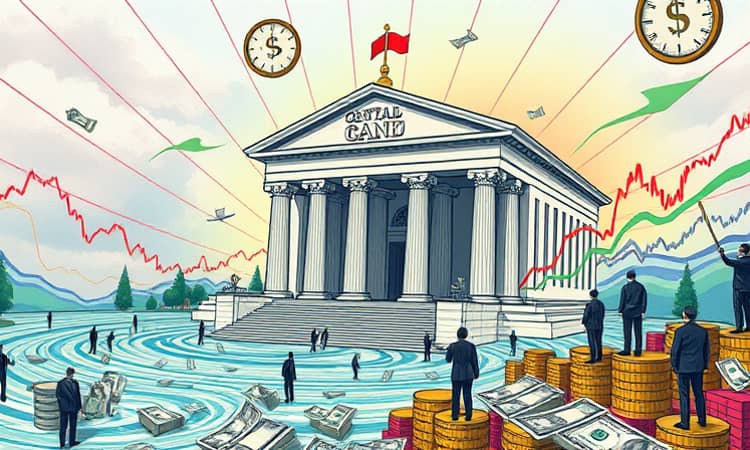
Central banks wield powerful tools to moderate growth, tame inflation, and safeguard financial markets. Among these, interest rate impulses play a defining role in shaping economic outcomes.
Understanding how rate adjustments cascade through banking systems, markets, and households illuminates the art and science of monetary policy.
Central Bank Mandates and Objectives
Every major central bank—whether the Federal Reserve, European Central Bank, or Bank of England—operates under clear mandates: maintain price stability, promote employment, and ensure financial stability. Price stability usually means an inflation rate of around 2 percent annually.
Inflation that drifts above or below target erodes purchasing power or signals weak demand. By guiding rates, central banks aim to preserve low, predictable inflation and sustain growth without overheating.
Key Monetary Policy Tools Affecting Interest Rates
While headline focus often falls on the policy rate, central banks deploy an array of instruments to steer short-term rates and overall liquidity.
- Administered rates: Directly set rates such as the discount window rate, interest on reserve balances, and overnight reverse repo rates.
- Open market operations: Buying or selling government securities to add or drain reserves, guiding interbank rates toward the policy target.
- Reserve requirements: Minimum ratios of deposits banks must hold, influencing how much they can lend.
- Standing facilities: On-demand lending or absorbing liquidity through facilities such as the discount window and deposit facilities.
- Other tools: Central bank liquidity swaps, repos, and targeted lending facilities during crises.
Interest Rate Transmission Mechanism
At the core of monetary policy is the monetary transmission mechanism, the path from policy rate moves to real economic activity.
First, central banks set the policy rate—known in the U.S. as the federal funds rate or in Europe as the repo rate. Commercial banks adjust their lending and deposit rates in response. As household mortgage rates, auto loans, and corporate bond yields shift, borrowing costs rise or fall.
Second, asset prices respond. Lower rates boost stock valuations and real estate, encouraging spending; higher rates dampen asset prices and curb credit growth. Finally, expectations adjust: businesses and consumers revise forecasts for inflation and growth, shaping hiring, investment, and consumption decisions.
Frameworks and Rules
To ground decisions in data, many central banks look to formulaic guides like the Taylor Rule. This rule prescribes a rate based on inflation deviations and output gaps:
it = r* + πt + α(πt – π*) + β(yt – y*)
Where r* is the natural real rate, π* the target inflation, and y* potential output. While not a strict mandate, the Taylor Rule framework provides a transparent benchmark against which policymakers can evaluate their stance.
Historical Fed Rate Ranges
Effects of Interest Rate Changes
Rate hikes and cuts serve distinct purposes:
- Hikes slow inflation by making borrowing more expensive, encouraging saving over spending.
- Cuts lower borrowing costs, spur investment and consumption, and support employment.
Key examples: During the 2008 global financial crisis, the Fed slashed rates from over 5% to near zero. In the pandemic of 2020, rates again fell to 0–0.25% to cushion economic collapse. By 2022, facing >9% inflation, the Fed raised rates above 5%—one of the fastest tightening cycles in decades.
Challenges and Trade-Offs
Finding the “Goldilocks” rate is complex. Rates set too high risk recession; too low, they can fuel inflation and asset bubbles. Moreover, monetary policy works with lags of six to eighteen months, complicating real-time calibration.
Global financial integration also means capital flows and speculative activity can dilute domestic policy effectiveness. During crises, central banks may coordinate swaps and joint liquidity provisions to restore calm.
Global and Comparative Perspectives
Though tools are consistent across advanced economies, mandates and emphasis differ. The ECB places strong weight on price stability, while the Fed balances inflation and employment more equally. The Bank of England also monitors currency movements alongside domestic goals.
Coordination in crises—such as the 2008 meltdown or the COVID shock—has led to synchronized rate cuts and liquidity injections, illustrating the interconnected nature of modern finance.
Implications for Consumers and Investors
Rate changes ripple beyond macro targets. Consumers and investors must adapt strategies:
- Borrowers: Mortgage, auto, and credit card rates track policy, altering monthly payments.
- Savers: Higher rates yield better returns on deposits, money markets, and bonds.
- Investors: Equity and real estate markets respond sharply to shifting cost of capital.
Conclusion
Interest rate impulses are the linchpin of modern monetary policy. By adjusting a few key rates, central banks send powerful signals that shape global credit, spending, and investment.
Understanding these mechanisms empowers businesses, policymakers, and households to navigate economic cycles with confidence. As central banks continue to refine their approach, the art of rate setting will remain central to steering the economy toward sustainable growth and stability.