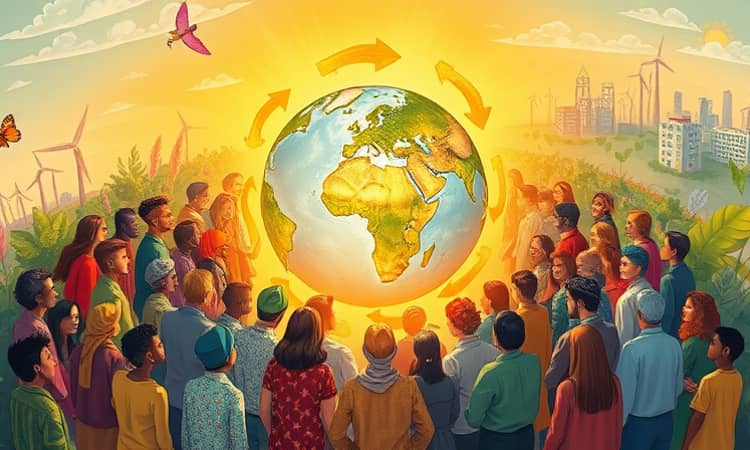
Every year, humanity extracts and consumes more resources than ever before, pushing our planet beyond its limits. We currently use 106 billion tonnes of materials per year, yet only 6.9% loops back into productive use. This widening circularity gap threatens ecological balance, economic stability, and social well-being. To close this gap, we must embrace the circular economy—a paradigm shift away from the wasteful linear model that dominates today.
What Is the Circular Economy?
The circular economy is an economic model aimed at eliminating waste and maximizing reuse by designing products and systems for longevity and resource efficiency. Unlike the linear “take-make-waste” approach, circularity strives to:
- Design out waste and pollution
- Keep products and materials in use
- Regenerate natural systems
These principles guide systemic redesign: from modular product design and repairability to shared-use models and closing material loops. By prioritizing durability and recyclability, we transform end-of-life products into input streams for new cycles.
Quantifying the Global Waste Crisis
Material consumption is outpacing both population growth and recycling improvements. Today, only 6.9% of materials are cycled back, down from 9.1% in 2018. Meanwhile, global municipal solid waste tops 2 billion tonnes per year, projected to reach 3.4 billion tonnes by 2050 under current trends.
Electronic waste is a particularly alarming segment. In 2022, just 22.3% of e-waste received formal recycling, a rate set to drop as e-waste generation grows five times faster than recycling capacity. If we attempted to recycle every product, the theoretical circularity rate could reach 25%, but technical and economic hurdles make this unfeasible without systemic innovations.
The Benefits of Circularity
Adopting circular practices yields profound environmental, economic, and social gains:
- Reduce greenhouse gas emissions: 70% of emissions stem from material extraction and processing. Circularity could cut up to 231 million tonnes of CO₂ annually in heavy industry.
- Enhance resource security: Lower dependence on virgin materials mitigates price volatility and supply-chain risks for critical minerals.
- Create jobs: The EU alone could see up to 700,000 new positions by 2030 in repair, remanufacturing, and recycling sectors.
- Drive innovation and savings: Longer-lasting products save consumers money and incentivize businesses to design for longevity.
How Circular Systems Work
Fundamental levers unlock circularity at every stage of the value chain:
- Circular design: Engineering products for modularity, repair, and easy disassembly.
- Resource efficiency: Streamlining manufacturing and logistics to minimize waste.
- Business model innovation: Shifting to product-as-a-service, leasing, and take-back schemes.
- Consumer engagement: Cultivating a culture of repair, reuse, and shared ownership.
Policies and regulations reinforce these shifts. The EU’s circular economy strategy, for example, mandates ecodesign standards, a right to repair, and stricter waste management, while the UN’s Global Waste Management Outlook calls for global adoption of circular frameworks.
Barriers and Challenges
Transitioning to circularity faces significant obstacles. Inadequate infrastructure in low-income countries means only 39% of waste is collected, versus 96% in wealthy nations. Recycling processes for mixed materials can be energy-intensive and economically unviable.
Planned obsolescence and short product lifecycles, especially in electronics, hamper reuse and repair. Limited incentives for manufacturers to design durable products persist, while global supply chains demand international standards and investment to harmonize practices.
Leading Examples and Case Studies
Several pioneering initiatives demonstrate circular success:
- In Europe, standardized reusable packaging systems have cut single-use plastic by over 40% in pilot cities.
- Corporations are adopting take-back schemes for electronics, recovering valuable metals and reducing e-waste.
- Urban resource hubs recycle construction and demolition debris into new building materials, slashing carbon footprints.
Data platforms like Circle Economy’s CGR® Dashboard collate millions of data points, helping policymakers track circular progress and identify priority sectors for intervention.
Projected Impacts: Circular vs. Linear Futures
Policy Momentum and Market Growth
The global circular economy market reached $463 billion in 2024 and is poised to grow to $517.8 billion in 2025 at a 12% CAGR. Governments are setting ambitious targets, from the EU’s 54% average recycling rate to UN resolutions on sustainable consumption. Businesses are aligning their strategies to remain competitive in a world where resources must be preserved, not wasted.
The Path Forward
To realize a truly circular future, stakeholders must:
- Invest in recycling and collection infrastructure, particularly in developing regions.
- Enact policies that reward durability over disposability.
- Educate consumers on the value of repair, reuse, and sharing.
- Foster international collaboration to set circular standards and finance large-scale projects.
By aligning economic incentives with ecological imperatives, we can transform waste into wealth and scarcity into abundance.
Conclusion
The circular economy offers a roadmap to a sustainable, resilient planet—one where materials stay in use for as long as possible and nature is allowed to regenerate. Closing the circularity gap isn’t just an environmental necessity; it’s an economic and social opportunity. Waste not, want not: the time to act on a global scale is now.