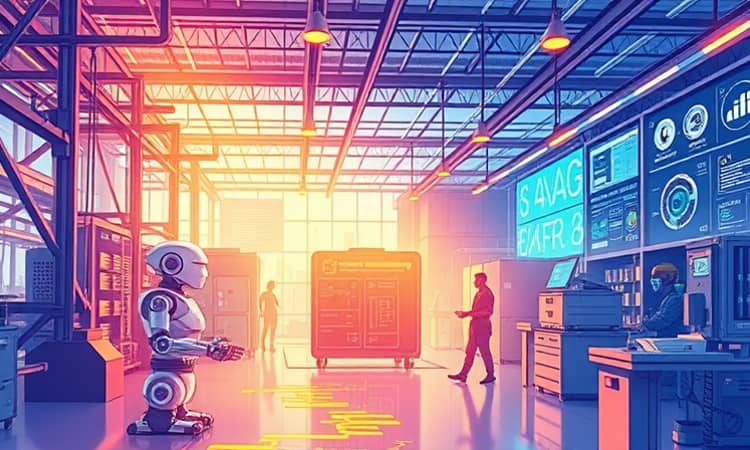
Manufacturing is entering an era defined by digital intelligence, local empowerment, and strategic autonomy. The convergence of automation, artificial intelligence, and reshoring is rewriting the rules of production, unlocking unprecedented speed, quality, and resilience.
Industrial Automation: Building the Smart Factory of Tomorrow
Over the past decade, factories have evolved from manual assembly lines to digitally integrated ecosystems. Investments in robotics and connected systems are projected to grow the global automation market to nearly $378.6 billion by 2030. This shift is powered by the Industrial Internet of Things (IIoT), edge computing, and advanced vision systems.
Automation delivers transformative benefits: it can dramatically reduce cycle times while simultaneously optimize machine utilization. By embedding sensors and analytics, manufacturers achieve real-time data analytics for predictive maintenance and can minimize quality defects through automated inspections.
- Industrial Internet of Things (IIoT) connectivity
- Collaborative robots (cobots) operating safely alongside humans
- 5G-enabled low-latency networks
- Edge and cloud computing platforms
- Machine vision and automated inspection
- Robust cybersecurity frameworks
Smart factories no longer exist as siloed pilots. They are rapidly scaling into unified digital ecosystems, where every asset—from CNC machines to warehouse conveyors—feeds actionable data into a central control horizon. This integration not only enhances throughput but also builds in operational agility, enabling swift production shifts in response to market trends.
Artificial Intelligence: From Predictive Maintenance to Generative Innovation
AI is the catalyst that transforms raw data into strategic advantage. In manufacturing, AI performs core functions such as predictive upkeep, defect detection, and supply chain optimization. By 2025, 80% of industry leaders plan to allocate at least 20% of their improvement budgets to AI and digital technologies.
Machine learning model applications include:
- Predictive maintenance to detect equipment failure risks before costly downtime
- Vision systems to enhance quality control processes with pixel-level defect spotting
- Production planning algorithms to optimize demand forecasting and inventory levels
- Generative AI engines to automate work instruction creation and troubleshooting guides
- Dynamic scheduling bots for real-time resource allocation
As AI takes on repetitive and analytical tasks, human roles evolve toward oversight, interpretation, and creative problem-solving. The workforce becomes a team of digital supervisors, guiding AI agents and interpreting insights for continuous improvement.
Reshoring: Reclaiming Manufacturing Sovereignty
Global events over recent years have highlighted the fragility of extended supply chains. The pandemic, geopolitical volatility, and surging logistics costs have driven over $3 trillion in announced US reshoring investments since 2025. This trend is not mere nostalgia—it is a strategic shift toward supply chain risk mitigation and strengthen manufacturing sovereignty.
Key drivers for reshoring include rising overseas labor costs, tariff uncertainties, and the growing recognition that balance total cost of ownership demands a holistic view of quality, speed, and risk. Case studies demonstrate that domestic sourcing can cut lead times to one week versus six for offshore suppliers.
- Government incentives for capital equipment expensing and workforce training
- Localized R&D and engineering hubs for rapid innovation cycles
- Sector focus on automotive and semiconductors, where automation enables competitiveness
- Contract manufacturers reshoring 5–10% of their portfolios
By co-locating design, prototyping, and production, companies create reinforcement loops of feedback, accelerating product refinement and reducing time to market.
How Automation, AI, and Reshoring Intersect
The interplay of these three forces produces a virtuous cycle of efficiency, innovation, and security. Automation lays the digital groundwork, AI activates intelligence, and reshoring anchors operations in strategic geographies.
When firms leverage automation to deliver intelligence and then localize production, they achieve accelerate delivery times domestically while maintaining the highest quality and flexibility.
Challenges and Strategic Considerations
Despite its promise, the integration of automation, AI, and reshoring faces hurdles. The 2024–2025 slowdown in capital spending, driven by economic uncertainty and inventory buildups, has tempered some investment plans. Meanwhile, expiring tax incentives for equipment purchases threaten to raise the cost of modernization.
Policy design must balance trade incentives with export competitiveness, avoiding retaliatory tariffs. Workforce bottlenecks remain a critical barrier: without targeted upskilling initiatives, technology adoption can stall.
Lastly, sustainability goals must be embedded from the outset. Automated, digitally monitored lines offer opportunities for energy and material efficiency, but they require governance structures to ensure environmental responsibility.
Charting a Path Forward: Strategies for Manufacturers
To thrive in this new landscape, manufacturing leaders should adopt a holistic strategy that weaves together technology, policy, and people.
- Invest in workforce retraining to foster continuous learning cultures
- Deploy integrated platforms to build cross-functional collaboration across engineering, production, and supply chain teams
- Align policy incentives effectively with long-term competitiveness by align policy incentives effectively
- Embrace sustainability as a core pillar to embrace sustainable practices fully and reduce environmental footprints
By prioritizing these pillars, companies can unlock the full potential of automation and AI while anchoring operations through strategic reshoring.
Manufacturing’s future is bright for those who see technology not as a cost center but as a catalyst for growth and resilience. As automation reduces variability, AI transforms data into insight, and reshoring rebuilds security, industry can usher in a new era of prosperity—one where innovation and purpose converge to redefine what’s possible.