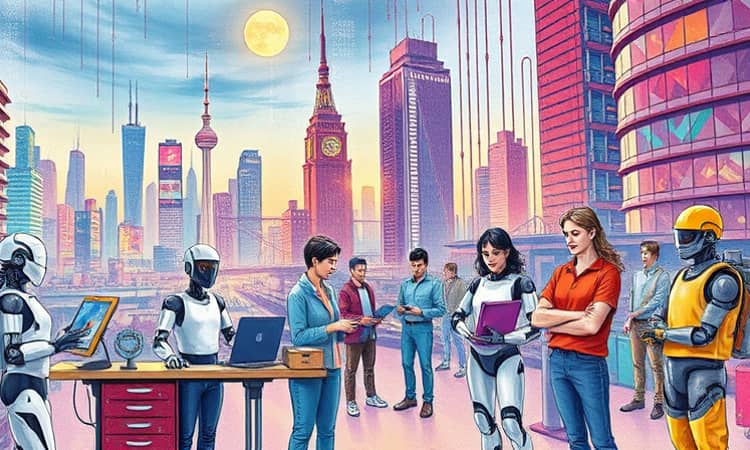
As we approach 2030, the global labor landscape is undergoing a profound transformation. Automation and artificial intelligence are reshaping how we work, where we work, and who finds opportunity in the new economy.
This article explores the challenges and opportunities ahead, offering insights and practical guidance to navigate this pivotal era.
Global Scale of Automation
Between 2025 and 2030, up to 300 million jobs globally could be displaced by automation and AI, affecting roughly 9.1% of the world’s workforce. Yet, this disruption carries a silver lining: forecasts predict net gain of 12–78 million positions as new roles emerge in tandem with technological progress.
The impact will vary by region. North America may see up to 70% of jobs exposed to automation by 2025, while Europe and Asia follow with significant—but sectorally distinct—shifts in employment patterns.
Sectoral Effects
No industry will be untouched. Some will face rapid upheaval, others will evolve through human–machine collaboration.
Education and training services are poised for growth, reflecting the global imperative to reskill and upskill workers for emerging roles.
Demographic and Regional Disparities
Automation’s effects will not be uniform. In the United States, roughly 58.9 million women hold roles highly exposed to AI, compared with 48.6 million men, highlighting a potential widening of gender gaps.
- Young workers (age 22–25) in tech roles have seen a 13% employment decline since 2025.
- High-wage white-collar professionals face moderate risk, especially in reporting and administrative support.
- Regions with high automation adoption—like North America and the UK—will experience the earliest and steepest shifts.
Economic and Productivity Impacts
Short-term unemployment spikes are expected, with projections of a 0.5 percentage point increase above trend during the AI transition. However, the long-term gains may be transformative.
- 15% rise in labor productivity in developed economies when generative AI is fully integrated.
- Annual savings of $8 billion through AI chatbots in customer support.
- Robotic process automation delivering 30–200% ROI within the first year.
Historical patterns suggest automation can compress within-industry wages by 8–14%, but AI may ultimately narrow wage inequality for most workers—excluding the very top earners.
Emerging Roles and Reskilling
The transformation is giving rise to entirely new professions. By 2025, we may see 350,000+ positions in areas such as prompt engineering, AI ethics oversight, and human–AI collaboration design.
Rapid growth of roles such as prompt engineers underscores the need for flexible, lifelong learning strategies. Experts estimate that 44% of workers will require significant retraining within five years to stay competitive.
Barriers to Transition
Despite the promise of automation, challenges loom large. Over 63% of roles include at least one non-technical barrier—cultural resistance, regulatory hurdles, or infrastructure gaps—that can slow deployment.
Furthermore, 70% of digital transformation projects fail to deliver on expectations, underscoring the complexity of integrating advanced technologies into existing systems.
Policy and Corporate Responsibility
Governments and businesses must collaborate on solutions that balance innovation with inclusion. Potential measures include:
- Expanding upskilling and reskilling programs to reach vulnerable populations.
- Strengthening social safety nets to cushion short-term job losses.
- Promoting gender equity initiatives in tech and automation-exposed fields.
The Path Forward
As we move toward 2030, a proactive stance can turn disruption into opportunity. Organizations that invest in training and embrace human-AI collaboration specialists will cultivate resilient, future-ready teams.
Workers who adopt continuous learning mindsets can transition into high-value roles—such as data strategists, AI ethics officers, and hybrid engineers—where human judgment and creativity complement machine efficiency.
Public policy must evolve in parallel, ensuring that innovation yields broad-based prosperity rather than concentrated gains. By prioritizing equitable access to education, retraining grants, and targeted support for displaced workers, societies can harness the full potential of automation.
Ultimately, the story of automation is not just about machines replacing tasks—it’s about people reimagining what work can be. With thoughtful planning, inclusive policies, and a commitment to lifelong learning, the future of work can be an era of unprecedented growth, creativity, and shared prosperity.