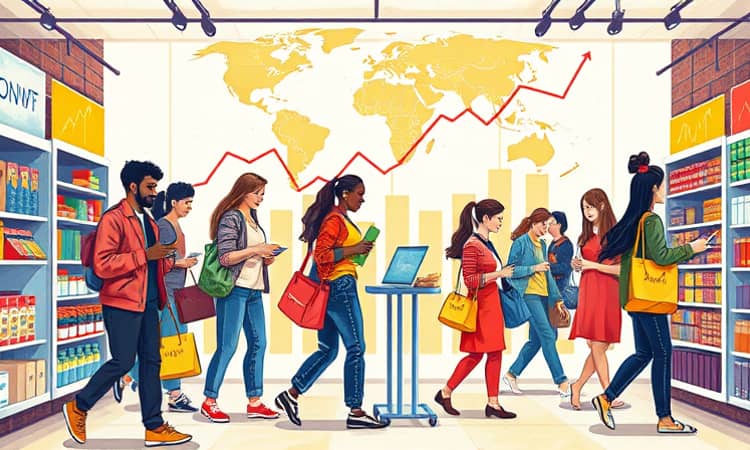
Consumer spending is the lifeblood of modern economies, accounting for the majority of GDP in advanced and emerging markets alike. By examining the drivers, trends, and future outlook, businesses and policymakers can harness this engine for sustainable growth.
The Scale and Economic Impact of Consumer Spending
Across developed nations, consumer spending accounts for over 70% of GDP. In the United States alone, households spent an astonishing $18.8 trillion in 2025, representing roughly two-thirds of the nation’s economic output. Such figures highlight the vast engine behind prosperity that everyday purchases create.
Globally, consumer outlays are projected to rise by $2.3 trillion in 2024—equivalent to adding the spending power of Germany in a single year. With more than half of the world’s population now in the consumer class (over 4 billion people), this segment continues to expand rapidly, particularly across Asia.
Generational and Income-Based Insights
Understanding who drives consumption reveals crucial patterns for market strategies and policy design. In 2025, Gen X leads global spending with $15.2 trillion, while Millennials and Gen Z shape demand through digital and sustainable preferences.
- High-income consumers fuel growth with lower debt and higher credit access.
- Low-income households face pressures from inflation and rising debt levels.
- Millennials and Gen Z prioritize eco-friendly and tech-enabled solutions.
Geographic differences within income tiers remain modest, but economic shocks—like layoffs or price spikes—hit lower-income groups harder, dampening consumption unpredictably.
Consumer Trends and Shifts (2025-2026)
Despite recent global disruptions, consumer demand has shown remarkable resilience. Amid elevated interest rates and geopolitical uncertainty, households continue to spend, particularly on essentials and technology-driven services.
Online channels maintain momentum, with e-commerce capturing a growing share of retail. The pandemic-driven shift to digital shopping, home delivery, and contactless payments has become a permanent fixture, fostering technology-driven convenience that consumers now expect.
Sustainability remains at the forefront: 58% of global consumers express willingness to pay more for eco-friendly options, and urban dwellers lead this movement. However, cost-conscious behaviors persist—74% worry about rising prices, 57% research purchases extensively, and 48% increase savings in response to inflation.
Sectoral Breakdown and Key Categories
Detailed analysis of spending categories highlights where growth is concentrated. In the U.S. for 2023, the average household spent $77,280, a 5.9% increase over the previous year. Key areas include housing, transportation, health, and leisure.
- Food and beverages: $1,350 per capita globally in 2025.
- Housing and utilities: the largest share of household budgets.
- Discretionary spending: up 2.6% in 2025, despite control categories dipping 0.2%.
Leisure and travel rebounded as restrictions eased, while health and wellness categories sustained growth driven by post-pandemic priorities.
Theoretical Context and Debate
Traditional Keynesian theory positions consumer spending as the primary driver of short-run growth and business cycles. In contrast, supply-side proponents argue that long-term prosperity stems from investment, productivity gains, and savings that fuel capital formation.
Empirically, consumer behavior serves as a leading indicator for policymakers and businesses. Rising household spending often precedes an uptick in corporate investment and job creation, reinforcing the central role of demand in economic dynamics.
Demographic, Regional, and Technological Drivers
Emerging markets are reshaping the global consumer landscape. Asia alone is projected to add 91 million new consumers in 2024, with India outpacing China in class growth. Latin America, Africa, and Southeast Asia also feature among the top growth regions.
Technological innovation further amplifies spending patterns. Fintech solutions, digital wallets, and seamless online experiences enable consumers to transact with unprecedented ease. Younger cohorts—Gen X, Millennials, and Gen Z—are at the vanguard, seeking differentiated experiences that blend convenience, speed, and personalization.
As new markets emerge and digital infrastructures mature, businesses must adapt their strategies to capture these evolving opportunities.
Risks and Future Outlook
While the outlook for consumer spending remains robust, several risks warrant attention. Rising inflation and household debt can constrain lower-income segments, potentially leading to increased delinquencies and reduced demand.
- Geopolitical tensions and supply chain disruptions may elevate prices further.
- Debt accumulation among vulnerable groups could trigger spending pullbacks.
- Policy shifts, such as higher interest rates, might cool exuberant sectors like real estate.
Nonetheless, forecasts project a 2.3% year-over-year rise in consumer spending for 2025, led by urban, tech-savvy populations. By 2031, the global consumer class could reach 5 billion people, with annual spending increases of $2.4 trillion. Such momentum underscores the enduring power of household demand to drive innovation, job creation, and broad-based prosperity.
In an interconnected world, consumer spending is not merely a statistic—it is a dynamic force that shapes markets, influences policy, and transforms societies. By understanding its nuances, stakeholders can navigate uncertainties and unlock the growth potential that lies within each transaction.