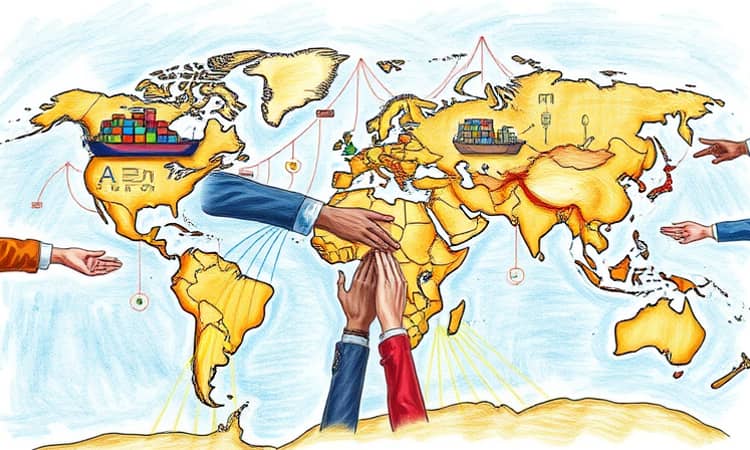
Global commerce has reached unprecedented levels in the first half of 2025, with trade values rising by about $500 billion, even as nations grapple with policy uncertainty and geopolitical tension. Beneath these record-setting trading values across markets lie complex realignments that will define the next decade. Old power structures are challenged by emergent blocs, and strategic competition is intensifying across continents.
This article offers a comprehensive, data-rich exploration of how alliances are evolving, the shifting balance between developed and developing economies, and the new frontiers of digital, green, and security-related trade. By weaving together analysis of major agreements, case studies, and risk factors, we aim to provide practical insights for policymakers, business leaders, and engaged citizens.
Overview of a Resilient but Volatile Landscape
Despite forecasts that global trade growth in 2025 would slow to around 1.8%, the first half saw a surprise surge of $500 billion on an annualized basis. Q2 figures showed goods trade up by 2.5% quarter-over-quarter, while services trade is expected to expand by 4% in Q3. On an annualized basis, goods grew about 5% and services grew approximately 6%. These numbers reflect underlying demand and recovery momentum across key sectors.
Manufacturing, led by electronics and hybrid/electric vehicles, remains the main engine of growth. At the same time, developing economies have taken the lead in driving South–South trade, offsetting a weak import performance from the United States, where monthly imports tumbled nearly 20% in April compared to March lows. Meanwhile, rising prices for traded goods point to further boosts in nominal trade values as 2025 progresses.
The Old Order: G7 and Transatlantic Alliances
The G7, anchored by the United States, Germany, Japan, the United Kingdom, France, Italy, and Canada, continues to exert significant influence over finished goods and services exports. Long-standing agreements, such as the EU–US framework on industrial cooperation and legacy transatlantic pacts, still manage large swathes of cross-border investment. However, growth forecasts for advanced economies have been sharply revised down by nearly half for 2025, highlighting structural headwinds in established markets.
Trade imbalances in these economies are also shifting. The European Union’s surplus has declined, while deficits have widened in Japan and the UK, reflecting complex supply chain reconfigurations and domestic demand fluctuations. Policymakers within the old order are now contemplating deeper integration on digital standards, energy transition support, and security protocols to shore up mutual resilience.
The New Order Emerges: BRICS+ and South–South Integration
The ascent of BRICS+, which now includes new members beyond Brazil, Russia, India, China, and South Africa, marks a defining pivot in global governance. This expanded bloc commands large shares of oil, gas, and critical minerals, fueling the industrial growth of member states. While the G7 still dominates value-added sectors, BRICS+ economies have increased their footprint in global production chains, exemplifying a multipolar rather than binary world order.
South–South trade continues its steady expansion, driven by shifting production chains and demand patterns. Regional economic unions—such as the Eurasian Economic Union and the Gulf Cooperation Council—are further tightening their integration frameworks, emphasizing tariff reductions, regulatory harmonization, and joint infrastructure projects. These platforms serve not only economic objectives but also strategic aims in a more contested global environment.
Case Studies in Realignment
Several landmark agreements in late 2024 and early 2025 illustrate how trade alliances are being rewired:
- CPTPP expansion to include the UK has boosted the bloc’s share to roughly 15% of global GDP.
- EU’s diversified negotiations with strategic partners signal a dual focus on old allies and fast-growing markets.
- US trade pacts with regional partners underscore renewed engagement across the Western Hemisphere and Southeast Asia.
These case studies reveal how major economies are calibrating their strategies to balance risk, access new markets, and maintain technological leadership.
The US–China Saga: Confrontation and Collaboration
In 2025, the US–China relationship has shifted decisively toward direct competition. Annual bilateral trade, still around $700 billion, now coexists with escalating tensions over industrial espionage, AI and semiconductor export controls, and digital sovereignty. The dispute over the South China Sea, through which one third of the world’s maritime trade passes, further complicates supply chain security and risk assessments.
China’s rapid advancements in advanced industries—particularly in green technologies, high-speed rail, and 5G—are narrowing the innovation gap. Meanwhile, the United States is forging tighter alliances with regional partners to safeguard critical supply chains and bolster cybersecurity norms. This dual narrative of confrontation and collaboration embodies the complexity of a relationship that remains both interdependent and adversarial.
Digital, Green, and Security Frontiers in Trade
New dimensions of trade are emerging at the intersection of technology, sustainability, and security. Digital sovereignty—control over data flows, standards, and privacy regulation—has become a key fault line among the US, EU, and China. Green trade, encompassing carbon border adjustment mechanisms, renewable energy equipment, and sustainable certification schemes, is also rising on policy agendas.
Furthermore, security considerations now include not only physical infrastructure but also cybersecurity, supply chain resilience, and export controls on dual-use technologies. These evolving rules and norms will shape the ease of market access, the cost of compliance, and the strategic choices of firms operating across borders.
Risks and the Road Ahead
Amid promising growth trajectories, several risks threaten to destabilize the delicate equilibrium of global trade:
- Volatile US trade policy and protectionist measures.
- Geopolitical hotspots from Ukraine to the Middle East disrupting supply corridors.
- Currency fluctuations and monetary policy shifts impacting commodity prices.
- Resurgent nationalism and fragmentation of multilateral frameworks.
Navigating these uncertainties will require enhanced cooperation, innovative policy tools, and a willingness to adapt to rapidly changing conditions. Businesses must build agile supply chains, while governments should pursue robust diplomatic engagement to maintain open markets and stable relations.
Conclusion: Toward a Stable “New Normal”
The shifting sands of global trade in 2025 present a paradox of record growth amid deep structural shifts. While emerging alliances and digital frontiers offer new opportunities, old rivalries and policy uncertainties pose significant challenges. The coming years will test the ability of nations to forge inclusive, resilient frameworks that balance competition with cooperation.
Ultimately, the future of trade will depend on the collective capacity of global actors to bridge divides, manage risks, and harness innovation. By understanding the complex tapestry of alliances and rivalries, stakeholders can better position themselves for success in an era of unprecedented change.