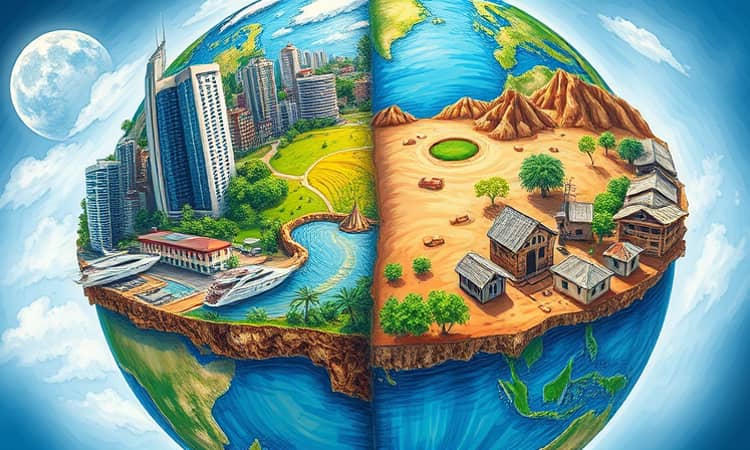
As global wealth continues to surge, the chasm between the richest and the rest threatens social stability and erodes hope. To confront this challenge, we must understand its scale, drivers, and lasting consequences—and chart an ambitious path toward a fairer future.
The Scale of Global Inequality
Since 2000, total global wealth has grown at a compound annual rate of 3.4%, accelerating to 4.6% in 2024. Yet this expansion has not been shared equally.
The richest 1% captured 41% of all new wealth between 2000 and 2024, while nearly 2,800 billionaires now control 3.5% of world wealth. In 2025, hold nearly half of the world’s personal wealth, underscoring how asset accumulation drives modern inequality.
Meanwhile, half of humanity—3.9 billion people—survives on less than $5.50 per day, reflecting a stark contradiction between global prosperity and individual hardship.
To illustrate the breadth of these disparities, consider Gini coefficients across nations:
These figures, ranging from 25.5 to 63.0, reveal systemic differences in how societies distribute resources.
Drivers of the Wealth Gap
Several intersecting forces have fueled this widening divide.
• Structural economic shifts have amplified returns to capital. Asset markets and tech-driven industries reward investors far more than traditional labor.
• Wealth accumulation via inheritance and capital gains perpetuates advantage across generations, while those without assets fall further behind.
• Unequal access to education, healthcare, and credit cements early disadvantages, making social mobility ever more elusive.
Social and Economic Consequences
Beyond statistics, inequality exacts a human cost. Restricted access to basic services exacerbates poverty and undermines health outcomes.
Inequality also fuels social tensions. As opportunities dwindle for many, disillusionment rises, fostering xenophobia, sexism, and political polarization.
Economic growth itself suffers. When purchasing power concentrates at the top, consumer demand stagnates and innovation slows. Moreover, political instability and weakened social cohesion threaten long-term progress.
Policy Responses and Practical Solutions
Governments, international organizations, and civil society are mobilizing to reverse these trends.
- Progressive taxation: Closing loopholes and implementing wealth taxes can redistribute resources and fund public services.
- Universal basic income: Providing a floor for all citizens helps stabilize livelihoods and reduce poverty traps.
- Education and healthcare investment: Ensuring quality access levels the playing field for future generations.
Corporate reforms also matter. Fair labor regulations, closing pay gaps, and combating monopolistic practices can distribute economic gains more broadly.
Furthermore, grassroots movements and community-based initiatives offer tailored solutions. Microfinance, cooperative enterprises, and local social funds empower marginalized groups directly.
International Coordination
Global inequality demands global action. The UN’s Sustainable Development Goal 10 calls for reducing inequalities within and among countries.
Major wealth transfers—over $83 trillion expected soon—must be managed responsibly. Countries like the US, Brazil, and China will play a critical role in shaping fair inheritance and capital gains policies.
Looking Ahead: A Call to Action
Inequality is not predestined. History shows that policy choices—tax reforms, social protections, and investment in human capital—can narrow gaps and foster shared prosperity.
Collective resolve is essential. Citizens, policymakers, and business leaders must unite behind bold, transformative reforms to ensure that economic growth benefits all, not just a privileged few.
As we face the prospect of the first trillionaire within a decade, we must also imagine a world where dignified living standards and opportunity are universal rights, not exclusive privileges.
By embracing equity-driven policies and sustaining pressure for systemic change, we can confront the wealth gap and build a more just, stable, and prosperous world for generations to come.